

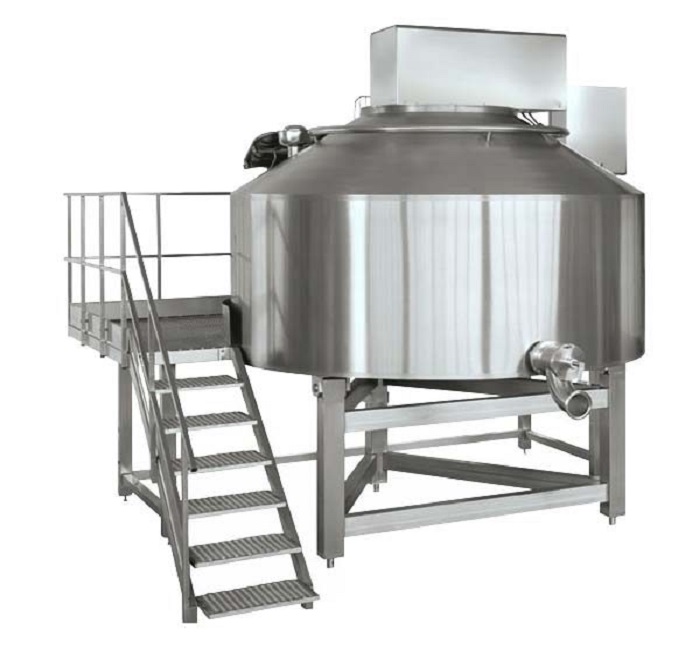
The food industry is one of the most sensitive industries in the world because food products enter the human digestive system directly and if they are contaminated or dangerous germs and bacteria, they can directly affect human health and possibly In many cases carry a fatal risk. For this reason, the pasteurization process must eliminate all microbes in food, including bacteria, viruses, protozoa and molds.
To order and inquire about the prices of various production line machines in Landa Industrial Group, contact the website numbers.
What is the process of pasteurization?
Pasteurization is a process in which by heating food, it kills germs in food or makes them harmless to the body. 90 to 99% of viruses and bacteria will be killed in this pasteurization method. The important thing about the pasteurization process is that after this process, the food may still be vulnerable to germs, so the way it is stored should be in accordance with the standards. Storing food longer than the time allowed for it to expire allows germs to grow again.
What is the purpose of food pasteurization?
Pasteurizing food will not only kill germs, but also increase the shelf life of food and increase its shelf life. If the process of pasteurizing food is not done properly, various diseases can be transmitted to humans through contaminated milk, contaminated meat and contaminated dairy products. Pasteurization has different methods, which we will examine in the following three of its methods.
Discontinuous pasteurization method
This method of pasteurization has a long pasteurization process but a low process temperature. For example, the temperature is about 60 degrees and the blowing time is about half an hour. This method of pasteurization is one of the most common and oldest methods that has been done at home in the distant past.
To order and inquire about the prices of various production line devices in Lavin Negar Daneshgar Industrial Group, contact the website numbers.
The food is heated by placing it in large pots, and in order for the food to be heated continuously, the material inside the pot is constantly stirred.
The tanks in which the food is placed are stainless steel and double-walled tanks with hot water or steam flowing between their two walls. When there is an intention to cool the food, the hot water flow is cut off and the cold water flows.
If the food is pure, the pasteurization temperature will be between 60 and 62.8 degrees Celsius, but if other products are added to it, this temperature should increase to about 65.2 degrees Celsius. Since the food is to be heated for a longer time in this pasteurization method, the temperature should not rise too much as the taste and quality of the food will be affected.
Continuous pasteurization method
In the non-continuous pasteurization method, the pasteurization temperature is high but the duration of this process is short. For example, food will be heated at a temperature of about 72 to 76 degrees Celsius for a quarter. This method of pasteurization has a much lower energy consumption and in this regard is time-saving and economical.
To order and inquire about the price of the firefighter dryer production line, contact the website numbers.
The heat source in the discontinuous pasteurizationn method is a heat exchanger and it must be cooled immediately after heating to the food.
Fast and continuous pasteurization
In rapid and continuous pasteurization, which is a branch of continuous pasteurization, the heat is transferred in such a way that all parts of the food reach the desired heat within a few seconds. You can then turn off the heat for a few seconds and cool the food. One of the advantages of this pasteurization method is that not only the milk germs are completely destroyed, there will be no traces of the taste of cooking or change of color and taste in the food or the milk itself.
To order and inquire about the price of the production line of work gloves, contact the website numbers.
On the other hand, the vitamins, proteins and nutrients of milk will not be lost. In pasteurization, tubular and plate heat exchangers are used in a fast and continuous manner.
Instant and continuous pasteurization (Fradema)
The third method of pasteurization is the immediate and continuous method in which the heating is more intense. The temperature in this method is between 88 to 130 degrees Celsius and the storage time of food at this temperature can be from a few tenths of a second to a few seconds. This time will be less than 2 seconds. If the heating time is longer than this amount, the milk sterilization process will take place.
In this method of pasteurization, the taste and color of milk will last longer than other methods. The color of milk will also be whiter. One of the advantages of instant and continuous pasteurization is that the amount of salts and minerals in milk will remain in milk more than other methods.
Conclusion
There are several ways to pasteurize milk and food. The three methods mentioned in this article are the methods used to pasteurize milk. Other methods such as
Steam sterilization and radiation and vacuum pasteurizations are other methods used to pasteurize beef, fruits and vegetables.
In the method of pasteurizations by radiation, gamma and beta rays are used to increase the shelf life of pasteurized food. The choice of pasteurizations method should be made according to the type and volume of food to be more effective in killing germs.

